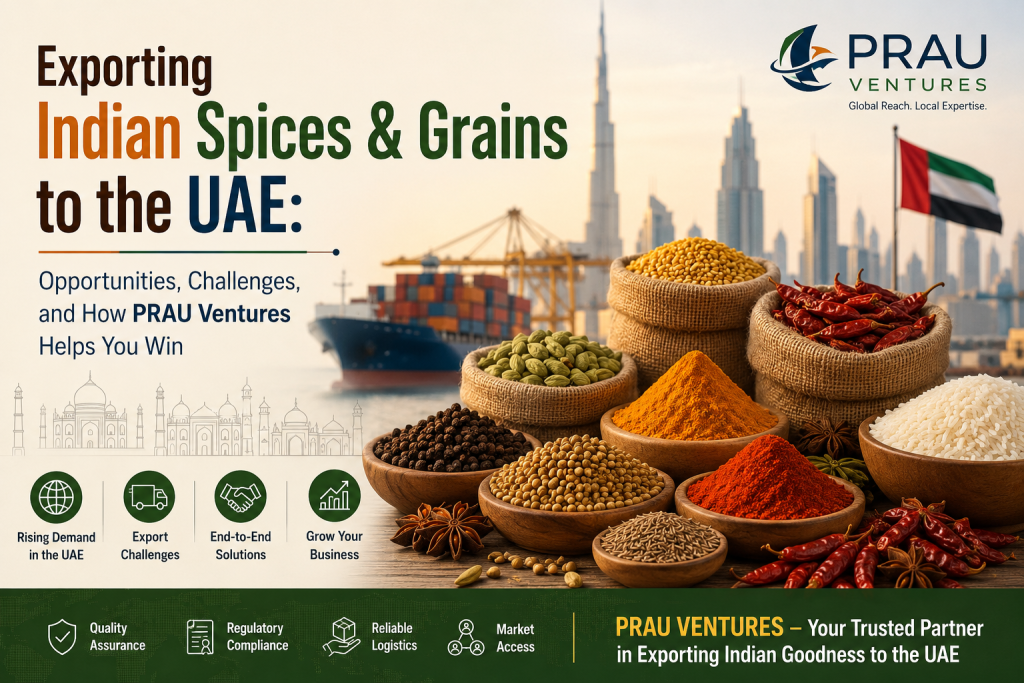
Planning to export Indian spices, grains, or agricultural commodities to the UAE? Discover the real challenges, market opportunities, and how PRAU Ventures helps international exporters establish a successful, compliant, and scalable business in the GCC
Why the UAE Is the World’s Gateway for Indian Commodities
The United Arab Emirates is not just a market — it is a gateway. Positioned at the crossroads of Asia, Africa, and Europe, and home to over 200 nationalities, the UAE offers international exporters something rare: a free-trade-friendly jurisdiction, a consumer base hungry for quality South Asian products, and re-export infrastructure that reaches 150+ countries through Jebel Ali Port and Dubai’s network of free zones.
For exporters of Indian spices, grains, pulses, and agricultural commodities, the UAE represents one of the highest-opportunity markets in the world. Indian products — from Tellicherry black pepper and Kashmiri chilli to 1121 Basmati rice and yellow maize — are not niche imports here. They are everyday staples demanded by millions of residents and re-exported across the wider GCC, East Africa, and Southeast Asia.
But getting into this market is not as straightforward as loading a container and booking a freight forwarder. The UAE has specific regulatory requirements, consumer expectations, documentation protocols, and distribution dynamics that catch even experienced exporters off guard.
This is where PRAU Ventures comes in.
The Indian Spice & Grain Export Opportunity in the UAE
India is the world’s largest producer, consumer, and exporter of spices, accounting for approximately 75% of global spice production. It is also among the world’s top exporters of rice, wheat, maize, and pulses. The UAE, meanwhile, imports nearly 90% of its food supply, making it one of the most import-dependent economies on Earth — and one of the most accessible for quality exporters.
Scale of Opportunity
UAE food imports exceed $12 billion annually, with a significant share from South Asia
Indian spice exports to the GCC are valued at over $300 million per year and growing
The South Asian diaspora in the UAE — numbering over 3.5 million — creates sustained, year-round demand for authentic Indian commodities
Dubai’s Jebel Ali Free Zone (JAFZA) is the world’s largest re-export hub, enabling exporters to reach MENA, East Africa, and CIS markets from a single base
Indian Spices in High Demand in the UAE
The UAE market has consistent, large-volume demand for the full spectrum of Indian spices. Here is a comprehensive list of Indian spices that are actively traded in the UAE market:
Whole Spices:
Black Pepper (Piper nigrum) — Tellicherry, Malabar, and Wayanad varieties
Green Cardamom (Elettaria cardamomum) — Elaichi, Kerala and Karnataka grades
Black Cardamom (Amomum subulatum) — Badi Elaichi, Sikkim and Darjeeling origin
Cloves (Syzygium aromaticum) — Laung, whole dried buds
Cinnamon / Cassia (Cinnamomum cassia) — Dalchini, whole bark quills
Cumin Seeds (Cuminum cyminum) — Jeera, Gujarat and Rajasthan origin
Coriander Seeds (Coriandrum sativum) — Dhania, whole and split
Fennel Seeds (Foeniculum vulgare) — Saunf, Rajasthan and Gujarat
Fenugreek Seeds (Trigonella foenum-graecum) — Methi, Rajasthan origin
Mustard Seeds (Brassica juncea / nigra / alba) — Rai, black, brown, and yellow
Ajwain / Carom Seeds (Trachyspermum ammi)
Kalonji / Nigella Seeds (Nigella sativa) — Black seeds
Star Anise (Illicium verum) — Chakra Phool
Bay Leaves (Cinnamomum tamala) — Tejpatta, Indian bay
Sesame Seeds (Sesamum indicum) — Til, white and black
Poppy Seeds (Papaver somniferum) — Khus Khus
Nutmeg (Myristica fragrans) — Jaiphal, whole dried
Mace (Myristica fragrans) — Javitri, dried aril
Long Pepper (Piper longum) — Pippali
Cubeb Pepper (Piper cubeba) — Kabab Chini
Black Cumin / Shah Jeera (Bunium persicum)
Caraway Seeds (Carum carvi) — Shahi Jeera variant
Cardamom Seeds (Elettaria cardamomum) — decorticated
Dried Red Chillies — Mathania, Byadagi, Kashmiri, Guntur, Kanthari varieties
Kashmiri Chilli (Capsicum annuum) — for colour and mild heat
Guntur Chilli — for high pungency export grades
Ground Spices & Powders:
Turmeric Powder (Curcuma longa) — Haldi, Erode, Salem, and Lakadong varieties, 3–7% curcumin
Coriander Powder — Dhania powder, from whole seed grinding
Cumin Powder — Jeera powder, ground and roasted
Red Chilli Powder — various grades from mild to extra-hot
Black Pepper Powder — freshly ground export grades
Ginger Powder (Zingiber officinale) — Saunth / Adrak, dried and milled
Cardamom Powder — green cardamom ground
Cinnamon Powder — Dalchini powder
Nutmeg Powder — Jaiphal ground
Garlic Powder — dehydrated and milled
Onion Powder — dehydrated, granules and powder
Amchoor Powder — Dried Mango Powder, souring agent
Asafoetida Powder (Ferula assa-foetida) — Hing, compounded and pure
Spice Blends:
Garam Masala — traditional and export blends
Chai Masala — tea spice blend
Biryani Masala — ready-to-use blend
Sambar Powder — South Indian spice blend
Rasam Powder
Chaat Masala
Pav Bhaji Masala
Kitchen King Masala
Tandoori Masala
Meat Masala / Curry Powder
Dried Herbs & Leaves:
Curry Leaves (Murraya koenigii) — Kadi Patta, dried
Fenugreek Leaves — Kasuri Methi, dried
Dried Mint Leaves — Pudina, food grade
Dried Basil — food grade, Indian origin
Indian Grains, Pulses & Commodities in High Demand
Beyond spices, Indian grains and agricultural commodities are pillars of the UAE food supply chain.
Key products include:
Rice:
1121 Basmati Rice — extra-long grain, premium biryani grade
HBC-19 / Traditional Basmati Rice — heritage aromatic variety
Type-3 / Ranbir Basmati — classic long-grain
Pusa Basmati (1509) — export-standard, ICAR certified
Sugandha Rice — semi-aromatic, economy grade
Sharbati Rice — soft, milky-sweet medium grain
PR-11 and PR-14 Non-Basmati — bulk institutional rice
Wheat & Flour:
Flour
Sharbati Wheat — MP origin, soft and sweet
Durum Wheat — pasta-grade export
Wheat Flour (Atta) — whole wheat and refined grades
Semolina (Suji / Rawa)
Maida — refined white flour
Pulses & Legumes:
Chana Dal — split Bengal gram
Masoor Dal — red lentils, whole and split
Moong Dal — green and yellow split moong
Toor Dal / Arhar Dal — split pigeon pea
Urad Dal — black gram, whole and split
Kabuli Chana — white chickpeas (garbanzo beans)
Desi Chana — small brown chickpeas
Rajma — kidney beans, red and white
Lobia — black-eyed peas
Vatana — dried green peas
Moth Beans (Vigna aconitifolia)
Oilseeds:
Groundnuts / Peanuts — raw, blanched, roasted grades
Sesame Seeds — natural, hulled, toasted
Mustard Seeds — for oil extraction
Sunflower Seeds — food and oil grade
Flaxseeds / Linseed
Other Commodities:
Maize / Corn — yellow and white, food and feed grade
Sorghum (Jowar)
Pearl Millet (Bajra)
Finger Millet (Ragi / Nachni)
Foxtail Millet (Kangni)
Barnyard Millet (Sanwa)
Quinoa — Indian-farmed export grade
Amaranth Seeds (Rajgira)
Sugar — ICUMSA 45 white refined, raw sugar
Jaggery — organic and conventional, blocks and powder
The Real Challenges International Exporters Face in the UAE
Despite the enormous opportunity, entering the UAE commodity market is not without friction. Exporters from India, Southeast Asia, and Egypt frequently encounter the same set of obstacles. Understanding them is the first step to overcoming them.
- Regulatory Compliance and Documentation
The UAE Food Safety Law (Federal Decree-Law No. 8 of 2019) is comprehensive and non-negotiable. Every food commodity entering the UAE must meet specific requirements:
Halal Certification — mandatory for most food products including processed spice blends
Certificate of Origin — issued by the relevant authority in the exporting country (APEDA for Indian agri exports)
Phytosanitary Certificate — required for all raw agricultural products
Food Safety Certificate — issued by the exporting country’s food authority (FSSAI in India)
Fumigation Certificate — for grains, rice, and pulse exports
Moisture Content and Aflatoxin Test Reports — particularly critical for groundnuts, maize, and spices
Pesticide Residue Reports — tested against EU-equivalent MRL standards in the UAE
Country-specific Conformity Requirements — ESMA (Emirates Authority for Standardization and Metrology) standards apply to labelling, weight accuracy, and packaging claims
First-time exporters often underestimate the lead time required to assemble this documentation and the consequences of non-compliance — including shipment rejection, quarantine, and fines.
- Labelling and Packaging Requirements
UAE labelling regulations are strict and enforced at the port of entry. All products must carry:
Arabic language labelling (mandatory, not optional)
Country of origin clearly stated
Ingredient list in Arabic and English
Net weight in metric units
Production and expiry dates in DD/MM/YYYY format
Allergen declarations
Storage instructions
Importers’ name and UAE address
Many exporters lose shipments or face costly re-labelling exercises at the port simply because packaging was designed for domestic or Western markets without UAE compliance in mind.
- Finding Reliable Distribution Partners
The UAE market is highly fragmented at the distribution level. Major retailers (Carrefour, Lulu Hypermarket, Spinneys, Union Coop, Nesto, Choithrams) each have their own supplier onboarding processes, shelf-space allocation systems, and payment terms. Breaking into modern trade without an on-the-ground partner is extremely difficult.
At the same time, the traditional trade channel — the spice souks and wholesale markets of Deira, Ras Al Khaimah, and Sharjah — operates on relationships and trust built over decades. Cold outreach rarely works here.
- Customs Tariffs, Free Zone Structure, and Re-Export Logistics
The UAE applies a 5% VAT and standard GCC customs tariffs on food imports. However, exporters who establish operations in a free zone (JAFZA, DAFZA, Dubai CommerCity, Sharjah Airport Free Zone) can benefit from:
100% foreign ownership
Zero corporate tax on qualifying income
Full repatriation of capital and profits
No customs duty within the free zone
Streamlined re-export to GCC and beyond
Navigating which free zone structure best suits a commodity trading business — whether a trading licence, a warehousing operation, or a full processing facility — requires local expertise. Getting it wrong means overpaying, over-complicating, or locking yourself into the wrong structure.
- Quality Consistency and Supplier Verification
UAE buyers, particularly large hospitality groups and institutional food service operators, demand consistent quality across shipments. A single lot of discoloured turmeric, a batch of adulterated chilli powder, or an off-spec rice shipment does lasting damage to a supplier relationship.
For exporters, the challenge is maintaining verified, audited supplier relationships at origin — not just finding the lowest price per metric tonne.
- Currency, Payment Terms, and Trade Finance
UAE buyers expect competitive payment terms — often 30–90 day credit periods for established relationships. For smaller exporters who need Letters of Credit (LC) or advance payment to finance production, bridging this gap is a real barrier to scaling.
- Market Pricing Intelligence
Without on-the-ground knowledge, exporters price into the UAE market blind. The result is either overpricing (losing deals to competitors with better market intelligence) or underpricing (leaving margin on the table and devaluing your product’s perception).
What PRAU Ventures Offers International Exporters
PRAU Ventures is a Dubai-based commodities and trade facilitation company specializing in spices, grains, pulses, and agricultural commodities across the GCC and international markets. We are not a broker — we are a business partner with boots on the ground in the UAE and direct relationships with suppliers across India, Sri Lanka, Indonesia, Egypt, Pakistan, and Vietnam.
Here is what we bring to exporters who want to enter or scale in the UAE:
Market Entry Strategy and Feasibility
Before you ship a single container, we help you answer the right questions: Which products have the strongest demand-supply gap in the UAE right now? Which buyer segments — modern trade, food service, wholesale, re-export — best match your volume and quality tier? What pricing positions you competitively without sacrificing margin?
We provide data-driven market entry assessments so you invest in the right direction from day one.
Regulatory Navigation and Documentation Support
Our team knows UAE food import compliance inside out. We work with exporters to:
Audit documentation against UAE import requirements before shipment
Guide FSSAI, APEDA, Halal, and phytosanitary certification processes
Ensure Arabic-language labelling compliance before goods arrive at port
Liaise with Dubai Municipality’s Food Safety Department and ESMA on your behalf
We have helped exporters avoid costly port rejections simply by catching documentation gaps before the container leaves origin.
Buyer Network and Distribution Access
We maintain active relationships with importers, distributors, and buyers across the UAE’s food trade ecosystem — from Deira’s wholesale spice markets to the buying teams at regional hypermarket chains, from hotel group procurement departments to re-exporters supplying East Africa and the GCC.
We can open doors that would otherwise take exporters years to access independently.
Free Zone Setup and Business Structuring
Whether you want to establish a trading company, a warehousing operation, or a full commodity processing facility in the UAE, we guide you through free zone vs. mainland structuring, licence types, and setup requirements. We have experience across JAFZA, DMCC (Dubai Multi Commodities Centre — the world’s largest commodities hub), Sharjah Free Zone, and others.
DMCC in particular is the global benchmark for commodities trading infrastructure, and for spice and grain exporters wanting a UAE base, it offers unmatched credibility and connectivity.
Quality Assurance and Pre-Shipment Inspection
We facilitate third-party pre-shipment inspections at origin for clients who need to provide quality guarantees to UAE buyers. This includes moisture testing, aflatoxin testing, curcumin content verification for turmeric, and piperine content testing for black pepper — the metrics UAE buyers and re-exporters actually care about.
Logistics and Trade Finance Facilitation
We work with established freight forwarders, customs clearing agents, and trade finance providers to help exporters manage end-to-end logistics. This includes FCL and LCL ocean freight from major Indian ports (Nhava Sheva / JNPT, Mundra, Chennai, Cochin) to Jebel Ali Port.
Pricing Intelligence and Market Monitoring
Our team tracks commodity pricing, seasonal supply dynamics, and competitive shifts in the UAE market continuously. Exporters who work with us price their products intelligently — informed by real market data, not guesswork.
Why the UAE — and Why Now
Several macro trends are converging to make the UAE commodity market particularly attractive for international exporters right now:
- Food Security Investment: The UAE government’s National Food Security Strategy 2051 is driving significant investment in food supply chain infrastructure, cold storage, and agri-tech. The government actively encourages diversification of food import sources.
- Expo Legacy and Tourism Growth: Post-Expo 2020 tourism momentum has pushed hospitality and food service demand to record levels. Hotel groups, restaurant chains, and catering companies are sourcing more volume.
- Growing South Asian Population: Indian, Pakistani, Sri Lankan, and Bangladeshi communities continue to grow, sustaining demand for authentic South Asian spices, rice, and commodities.
- Re-Export Opportunity to Africa: The UAE is increasingly the preferred transit hub for Indian commodities destined for East Africa, West Africa, and the Horn of Africa — markets with enormous, underserved demand.
- D2C and E-Commerce Growth: Platforms like Noon, Amazon UAE, and regional grocery delivery apps are creating new channels for branded spice and grain products that don’t require traditional retail shelf space.
Getting Started: Your Next Steps
If you are an exporter of Indian spices, grains, pulses, or agricultural commodities and you are considering the UAE as your next market — or if you have already started but are hitting walls around compliance, distribution, or pricing — PRAU Ventures is ready to work with you.
Here is how we typically begin:
Initial Consultation — We learn about your products, volumes, current certifications, and target segment
Market Fit Assessment — We identify where your products have the strongest UAE opportunity
Gap Analysis — We flag documentation, labelling, or certification gaps that need resolution
Engagement Proposal — We outline a customised support structure: market entry, distribution, setup, or ongoing trade facilitation
Execution — We work alongside you, on the ground in the UAE, to deliver results
Conclusion
The UAE commodity market rewards exporters who come prepared — with the right documentation, the right partners, the right pricing strategy, and the right market intelligence. Indian spices, grains, and agricultural commodities are in genuine, sustained demand here. The window is open. The question is whether you have the local support to walk through it confidently.
PRAU Ventures exists to make that journey faster, safer, and more profitable for international exporters who are serious about the GCC.
Ready to explore the UAE market for your spices or grains?
Contact us at info@prauventures.com or visit prauventures.com to schedule a consultation with our commodities team.
PRAU Ventures | Dubai, United Arab Emirates Specialising in Spices, Grains, Pulses & Agricultural Commodities | GCC Market Entry & Trade Facilitation
Indian spices UAE, export spices to Dubai, grain export UAE, basmati rice export UAE, commodity trade GCC, spice trade Dubai, UAE food import, PRAU Ventures, turmeric export UAE, black pepper export, cardamom trade UAE, cumin export, coriander export, rice export India UAE, pulse export UAE, Dubai commodity market, GCC food trade, UAE market entry, JAFZA food trade, DMCC commodities